
See announcement in Dutch below.
With an official kick-off by Executive Vice-President of the European Commission Henna Virkkunen, Minister Heleen Herbert of Economic Affairs and Climate Policy and Minister of Defence Dilan Yeşilgöz-Zegerius, the Netherlands today strengthens its position as a global leader in technology. TNO and High Tech Campus Eindhoven are starting the construction of the world's very first industrial factory for the production of Indium phosphide photonic chips on a 6-inch wafer scale. By connecting R&D with scalable production, this facility accelerates the route from concept to concrete solutions for the market. This paves the way for a new generation of energy-efficient AI data centers, 6G networks, medical innovations, and supercomputers.
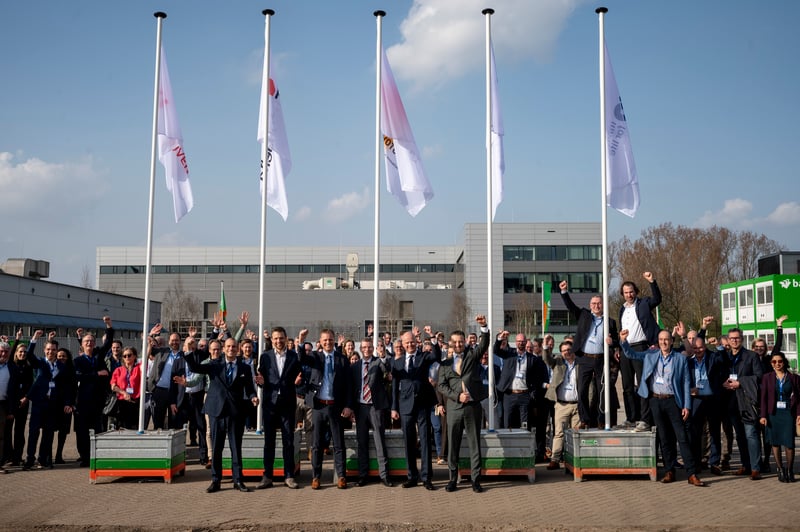
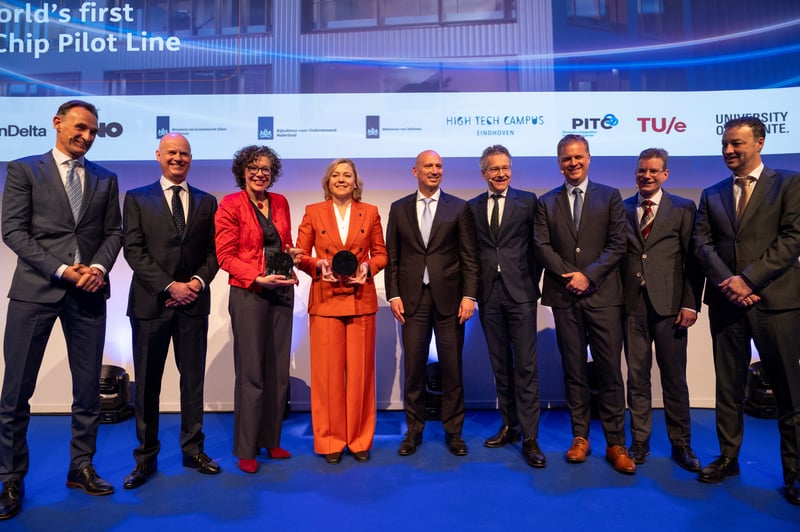
Pictured from left: Arnaud de Jong, Managing Director High Tech Systems at TNO; Otto van den Boogaard, CEO High Tech Campus Eindhoven; Heleen Herbert, Dutch Minister of Economic Affairs and Climate Policy; Henna Virkkunen, Executive Vice-President of the European Commission for Technological Sovereignty, Security, and Democracy; Tjark Tjin-A-Tsoi, CEO, Chairman of the Board at TNO; Jeroen Dijsselbloem, Mayor of Eindhoven; Eelko Brinkhoff, CEO of PhotonDelta; Johan Feenstra, CEO of SMART Photonics; Ton van Mol, Director Flexible and Free Form Electronics at TNO. Photo courtesy of TNO.
The critical link between 'lab and fab'
The new factory is more than a facility; it is a national and European driving force for innovation. With the demand for photonic chips, which process data with light instead of electricity, growing exponentially, TNO provides a critical function in the ecosystem by providing the infrastructure to test and validate this technology safely and on an industrial scale.
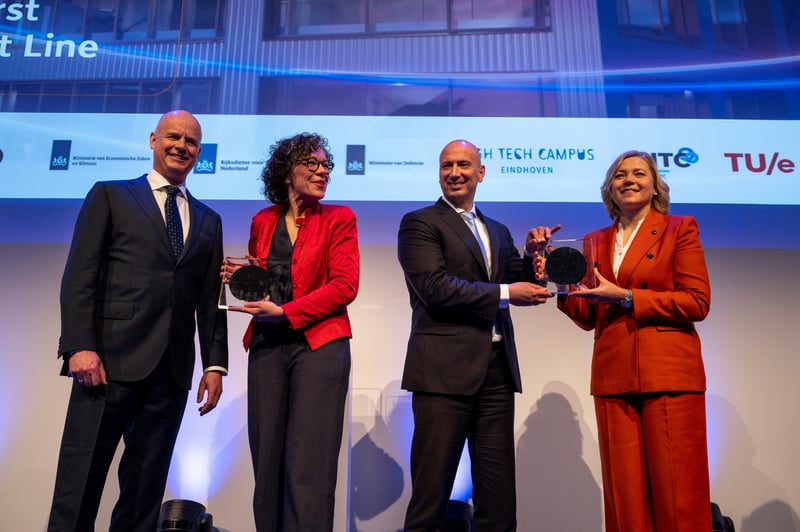
Pictured from left: Otto van den Boogaard, Heleen Herbert, Tjark Tjin-A-Tsoi and Henna Virkkunen. Photo courtesy of TNO.
"With this factory, TNO is taking a unique step: for the first time, we are building an industrial pilot line. By bringing research and production close together, we strengthen the position of the Netherlands within the European semiconductor landscape and help companies to scale up high-quality photonic technology faster and more efficiently. This is an investment in our technological strength and in future economic growth," says Tjark Tjin-A-Tsoi, CEO of TNO.
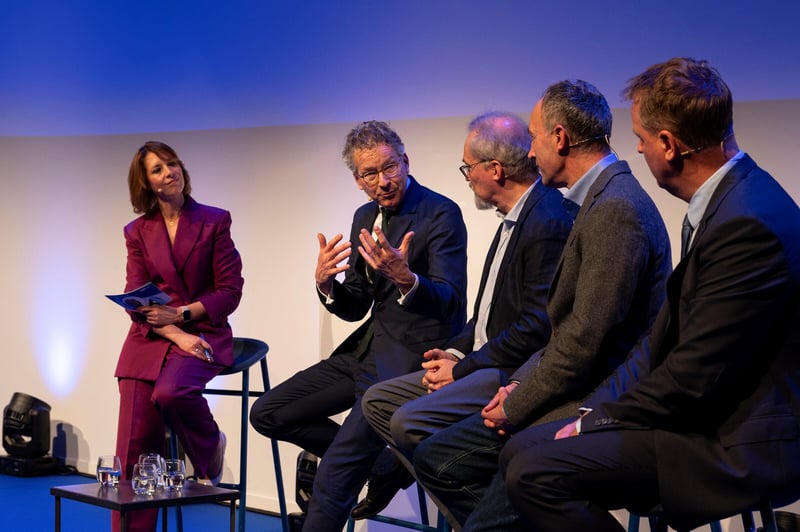
Panelists second from left: Jeroen Dijsselbloem, Mayor of Eindhoven; Jari Kinaret, Executive Director Chips Joint Undertaking; Valerio Pruneri, ICFO Group Leader and Director PIXEurope; Eelko Brinkhoff, CEO of PhotonDelta. Photo courtesy of TNO.
Strategic autonomy for Europe
The investment of 150 million euros is a direct result of the ambition of the European Chips Act. As part of the pan-European consortium PIXEurope, the factory must ensure that the "brains" of the future digital economy are developed and produced on its own soil.
Minister Heleen Herbert (Economic Affairs and Climate): "With this investment, we will work to move from knowledge and innovation to concrete applications of integrated photonics. Our goal is to use this key technology to gain a strong European competitive position. Both when it comes to knowledge, innovation, supply and final production. This is necessary for the Dutch jobs and income of the future, solving social challenges and our national security."
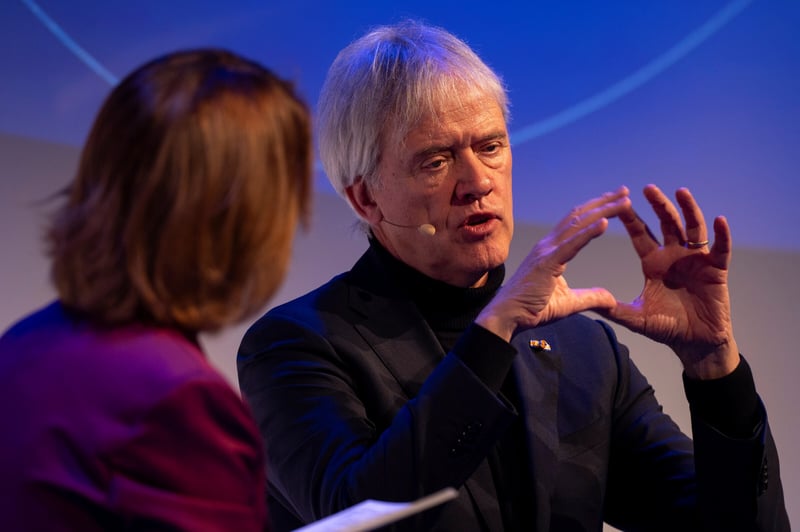
Peter Wennink, government advisor and former CEO of ASML. Photo courtesy of TNO.
Cooperation and employment
The project is a powerful public-private partnership between TNO, TU/e, PhotonDelta, SMART Photonics and High Tech Campus Eindhoven. In addition to technological gains, the factory immediately provides high-quality employment. After the start-up phase, approximately 40 specialists will be working in the factory, a number that is expected to increase further.
According to government advisor Peter Wennink, the impact of integrated photonics is comparable to the rise of integrated electronics decades ago: "By investing in scalable production capacity now, we are creating an ecosystem that can help determine the global technological course. This is a launching pad for Europe's future digital economy".
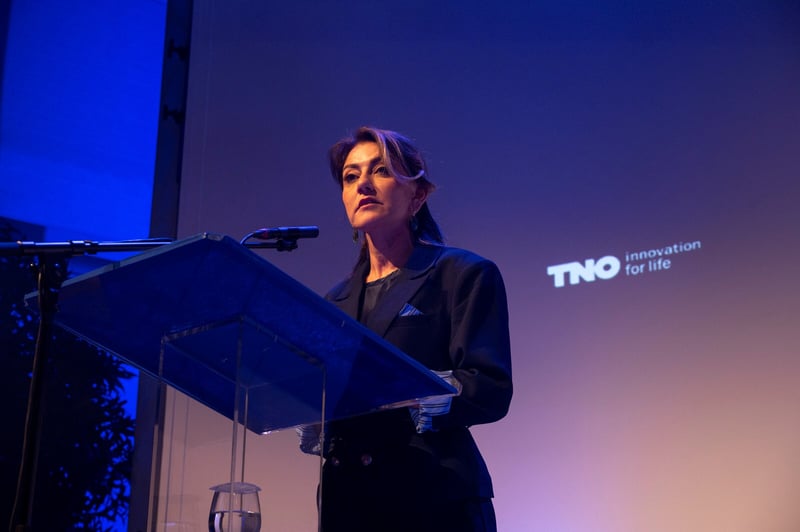
Minister of Defence Dilan Yeşilgöz-Zegerius. Photo courtesy of TNO.
Bouw industriële fotonische chipfabriek in Eindhoven van start
Met een officieel startsein door uitvoerend vicevoorzitter van de Europese Commissie Henna Virkkunen, minister Heleen Herbert van Economische Zaken en Klimaat en minister Dilan Yeşilgöz-Zegerius van Defensie, zet Nederland vandaag een cruciale stap naar de technologische wereldtop. TNO en High Tech Campus Eindhoven beginnen de bouw van ’s werelds allereerste industriële fabriek voor de productie van Indiumfosfide fotonische chips op 6-inch wafer schaal. Door R&D te verbinden met schaalbare productie, versnelt deze faciliteit de route van concept naar concrete oplossingen voor de markt. Dit maakt de weg vrij voor een nieuwe generatie energiezuinige AI-datacenters, 6G-netwerken, medische innovaties en supercomputers.
De kritieke schakel tussen ‘lab en fab’
De nieuwe fabriek is meer dan een faciliteit; het is een nationaal en Europees vliegwiel voor innovatie. Nu de vraag naar fotonische chips, die data verwerken met licht in plaats van elektriciteit, exponentieel groeit, biedt TNO een kritieke functie in het ecosysteem door de infrastructuur om deze technologie veilig en op industriële schaal te testen en te valideren.
"Met deze fabriek zet TNO een unieke stap: voor het eerst bouwen we een industriële pilot line. Door onderzoek en productie dicht bij elkaar te brengen, versterken we de positie van Nederland binnen het Europese halfgeleiderlandschap en helpen we bedrijven om sneller en efficiënter hoogwaardige fotonische technologie op te schalen. Dit is een investering in onze technologische slagkracht én in toekomstige economische groei," aldus Tjark Tjin-A-Tsoi, CEO van TNO.
Strategische autonomie voor Europa
De investering van 150 miljoen euro is een direct resultaat van de ambitie van de Europese Chips Act. Als onderdeel van het pan-Europese consortium PIXEurope moet de fabriek ervoor zorgen dat de 'hersenen' van de toekomstige digitale economie op eigen bodem worden ontwikkeld en geproduceerd.
Minister Heleen Herbert (Economische Zaken en Klimaat): “Met deze investering gaan we aan de slag om van kennis en innovatie naar concrete toepassingen van geïntegreerde fotonica te komen. Ons doel is om met deze sleuteltechnologie een sterke Europese concurrentiepositie te krijgen. Zowel als het gaat om kennis, innovatie, toelevering als eindproductie. Dat is nodig voor de Nederlandse banen en inkomsten van de toekomst, het oplossen van maatschappelijke uitdagingen en onze nationale veiligheid.”
Samenwerking en werkgelegenheid
Het project is een krachtige publiek-private samenwerking tussen TNO, TU/e, PhotonDelta, SMART Photonics en High Tech Campus Eindhoven. Naast technologische winst levert de fabriek direct hoogwaardige werkgelegenheid op. Na de opstartfase zullen circa 40 specialisten in de fabriek werkzaam zijn, een aantal dat naar verwachting verder zal toenemen.
Volgens regeringsadviseur Peter Wennink is de impact van geïntegreerde fotonica vergelijkbaar met de opkomst van de geïntegreerde elektronica decennia geleden: "Door nu te investeren in schaalbare productiecapaciteit, creëren we een ecosysteem dat de wereldwijde technologische koers mede kan bepalen. Dit is een lanceerplatform voor de toekomstige digitale economie van Europa".